UAE’s $54 Billion energy plan and its impact on Tech companies

The United Arab Emirates has announced an injection of AED 150 to 200 billion (up to $54 billion) into energy infrastructure by 2030, guaranteeing uninterrupted supply and ultra-competitive rates for intensive industries, artificial intelligence, and data centers choosing Dubai to scale globally without risks of rationing or runaway costs.
Key highlights in 1 minute
- Massive Investment Confirmed: Up to AED 200 billion channeled into energy generation, smart grids, and storage between now and 2030.
- Real Renewable Advancement: Clean energy closed 2025 reaching 32.4% of the national electricity mix, well on track for the 35% target set for 2031.
- Priority for the Tech Sector: Explicit safeguarding of electrical capacity to meet the surge in demand from data centers and artificial intelligence.
- Stable Industrial Rates: Mitigation of international volatility through coordinated integration of natural gas, nuclear power (Barakah), and solar energy.
Many entrepreneurs we advise at our MyDubaiWay team often focus solely on taxation when planning their relocation. This is a common mistake. The tax regime is only half of financial success; the other half is the operational resilience of the country where you establish your assets.
Europe and parts of America are suffering severe electricity grid bottlenecks, toll increases, and stifling regulations. Meanwhile, the UAE’s Minister of Energy and Infrastructure, Suhail Al Mazrouei, has just set a roadmap at ADIPEC 2026 that defines energy not just as a basic supply, but as the ultimate economic shield to attract cross-border capital.
Why UAE’s energy sovereignty shields Tech companies
If you operate a software, cloud computing, digital mining, or advanced analytics company, your electricity bill is not a secondary expense. It’s your most sensitive operational cost line after payroll. A data center without guaranteed continuous supply or subject to 40% price hikes per kilowatt-hour within months destroys any five-year projected financial model.
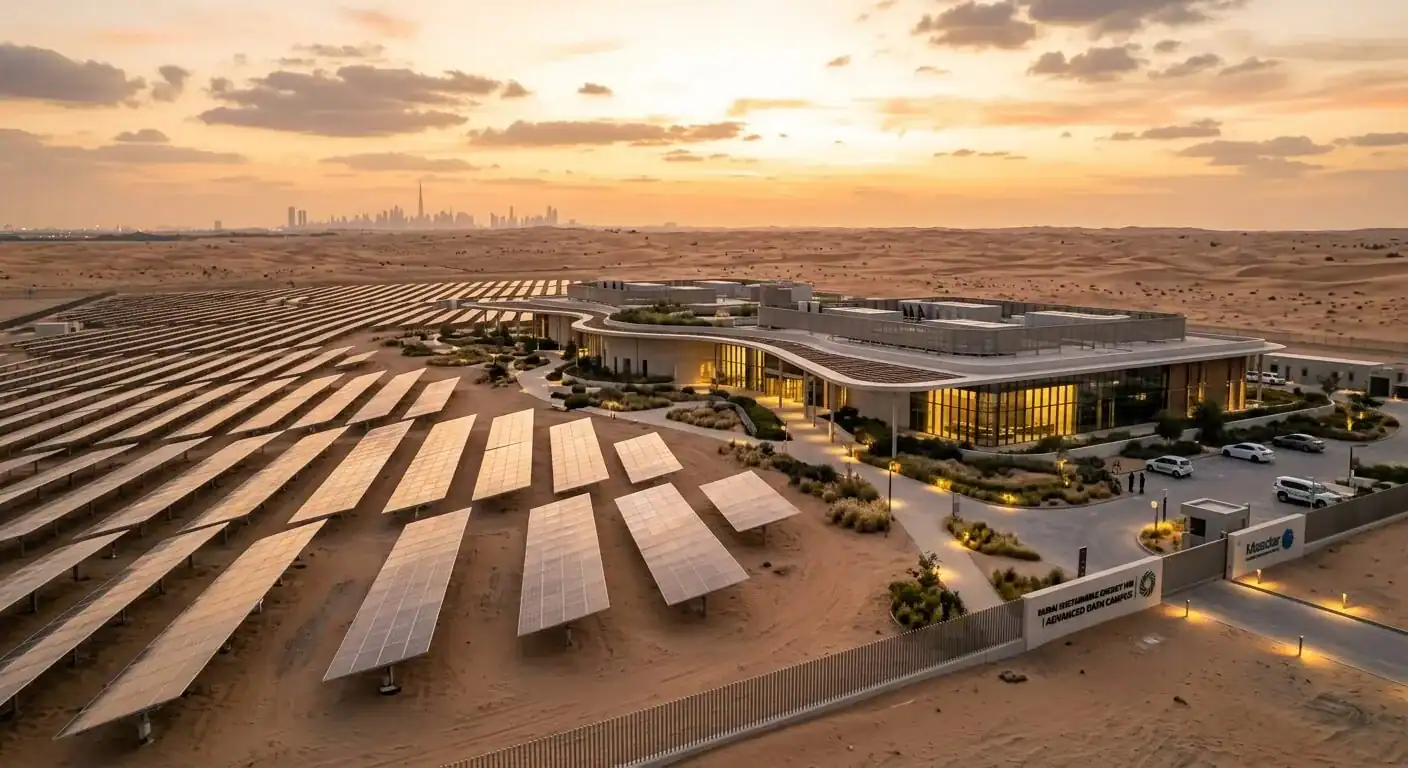
The UAE has understood that to become the world capital of artificial intelligence, it needs constant, predictable, and decarbonized electrical power. The governmental plan announced by the UAE Ministry of Energy and Infrastructure integrates three simultaneous pillars: constant nuclear power (the fully operational Barakah plant), massive-scale solar energy (like the Mohammed bin Rashid Al Maktoum Solar Park in Dubai), and high-efficiency combined-cycle gas plants.
“Energy security is not just about ensuring sufficient supply; it’s about building a competitive and integrated system capable of supporting industrial growth and responding flexibly to geopolitical shocks.” — Suhail Al Mazrouei.
This integration is not theoretical. It allows companies to calculate their cost structures with long-term energy contracts, which have simply ceased to exist in most OECD countries due to regulatory instability.
Breakdown of the 2026-2030 energy plan: operational figures
To understand the scale of what is being executed on the ground, it’s worth putting the numbers into perspective against the usual challenges international corporations face in other geographies:
| Operational Parameter | United Arab Emirates (2026 – 2030) | Traditional Western Markets |
|---|---|---|
| Investment in Grid & Generation | AED 150 to 200 billion direct investment | Fragmented funds and stalled procedures |
| Clean Energy Share | 32.4% current (35% target by 2031) | Ambitious targets with premature thermal closures |
| Average Industrial Connection Time | Weeks to months in specialized zones | 2 to 5 years due to substation saturation |
| Energy Tariff Predictability | Regulated, subsidized, and long-term | Indexed to volatile markets and carbon taxes |
What does this table mean for your bottom line? Balance sheet security. When you decide to set up a company in Dubai, you’re not just avoiding endless bureaucracy; you’re connecting your business to an ecosystem that invests in capacity before system collapse.
Direct impact on operational costs and infrastructure
Cheap and stable energy benefits not only those building logistics warehouses or factories in Dubai South or KIZAD. It has direct ramifications for high-value service sectors:
- Local Server Hosting Costs: The proliferation of data centers in the Emirates drastically lowers hosting costs and latency for financial services, fintech platforms, and Software as a Service (SaaS) companies serving the Middle East, Asia, and Africa.
- Carbon Tax Exemption: While the European Union tightens its Carbon Border Adjustment Mechanism (CBAM) and increases the cost of domestic production, the UAE optimizes its clean energy matrix so that exporting companies based here are not subject to international penalties.
- Domestic Supply Stability: On a personal level, home air conditioning and electrification do not become an economic nightmare during the summer, guaranteeing constant thermal comfort without surprise costs.
Added to this is the corporate framework. The combination of a modern grid with competitive corporate taxation in Dubai (9% on applicable profits, with extensive exemptions for qualifying income in Free Zones) makes the emirate the most efficient financial destination on the planet for advanced technological activities.
Our advisors’ perspective on industrial and Tech relocation
From the MyDubaiWay operations desk, we see how founders’ priorities change daily. Three years ago, inquiries were almost 100% about personal taxation and income tax. Today, more sophisticated clients come asking about power quotas, substation access, and ESG compliance without sacrificing profit margins.
Last month, we structured the relocation of a group focused on medical image processing and language models for telemedicine. They had their servers distributed across two European countries. The problem: one of their electricity grid providers notified them that a power upgrade would require a technical wait of almost three years due to local grid restrictions. Their expansion was frozen.
The solution we designed was comprehensive: we established their structure in a technology Free Zone with direct access to local Tier III and Tier IV certified data centers, processed corporate visas for their engineering team, and optimized their intellectual property holding. Today, they pay an energy rate 38% lower for their dedicated servers, operate under an optimized Corporate Tax framework, and their latency to Southeast Asia and Europe has been halved.
Infrastructure is not an accessory detail; it’s the engine that sustains the long-term viability of any business.
Plan your corporate setup with structural support
The AED 200 billion plan through 2030 confirms a reality: the Emirati government plans decades in advance and executes its projects with real budgets, not empty declarations of intent.
If you run a company with intensive computing requirements, light manufacturing needs, or are simply looking to establish your residence and wealth holding in a jurisdiction that won’t cut your power or drain your cash with energy taxes, now is the time to act.
At MyDubaiWay, we handle the entire process: from the initial tax diagnosis to the incorporation of your business, opening your bank accounts, and comprehensive management of your residency visas. If you want to assess the viability of your structure, let’s analyze your relocation case with no obligation and design a secure roadmap for your assets.
Calculator: how much you could save in Dubai
US citizens and green card holders remain taxable in the US wherever they live: the estimate only reflects the foreign earned income exclusion (USD 130,000 in 2025) on salary income.
Indicative estimate of personal income tax using the general rates in force, without personal reliefs or local taxes. The saving is only real if you stop being tax resident at home (day-count tests and ties) and plan any exit charges in advance.
Exit guides for your home country
Sources and references
- moei.gov.ae. UAE Ministry of Energy and Infrastructure
How we produce this content: editorial policy. Informational content. It does not replace tax or legal advice on your specific situation; regulations may change.
About the author
Albert Montasell
Head of Finance · Registered economist no. 216 (COEA)
Albert Montasell is the founder of MyDubaiWay. His background combines business administration and law, and his career has focused on financial management: financial planning, corporate structures, intercompany operations, international treasury and tax compliance. Today he is Head of Finance at a company, as his LinkedIn profile shows, and he is registered economist no. 216 at the Col·legi d’Economistes d’Andorra. He applies that international consulting experience to every relocation, together with a selected network of partner lawyers and advisers in the UAE.